Rails: How to Use Greater Than/Less Than in Active Record where Statements
When querying ActiveRecord for greater than and less than, most people turn to including raw SQL in their codebase... But raw SQL isn't required!
Ally Piechowski · · 2 min read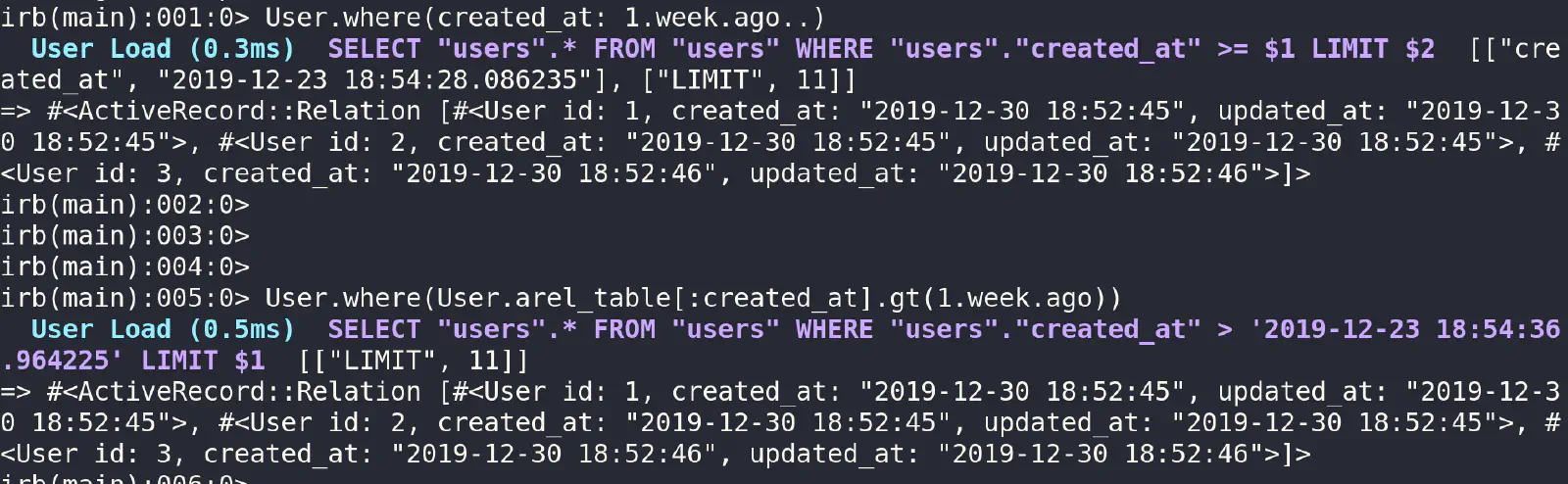
For example, if I want to find all users created within the last week, I would
ask for all users from my User model in which the column updated_at is
greater than 1 week ago, or 1.week.ago.
1. Using Ruby’s Infinity Range (Best)
In Rails 5+ and Ruby 2.6+, the infinity range can be used like so:
User.where(created_at: 1.week.ago..)
If you haven’t upgraded to Ruby 2.6 yet, you can specify the end of the range as
the constant Float::INFINITY:
User.where(created_at: 1.week.ago..Float::INFINITY)
This is the best option because it is the closest syntax to actuality.
From 1 week ago until infinity == greater than or equal to 1 week ago
It also doesn’t have any of the caveats that using a raw string has (explained later in this post)
2. Using Active Record’s Arel Table
Utilizing arel directly, we can signal to ActiveRecord the logical SQL we want to do functionally:
User.where(User.arel_table[:created_at].gt(1.week.ago))
When faced with a challenging ActiveRecord Query that doesn’t fit into the core
ruby-style syntax, I typically turn to Arel to provide me with a functional
core and extra safety.
3. Using a Raw String (Worst)
In ActiveRecord, it’s possible to utilize a raw string to access sql’s interface directly, like so:
User.where('users.created_at > ?', 1.week.ago)
Or even the keyword interpolation style:
User.where('users.created_at > :after_date', after_date: 1.week.ago)
While this works, using SQL strings with ActiveRecord isn’t always the best due to:
- Higher risk of accidental sql injection vulnerabilities
- Reduced database adapter compatibility